BSc Chemistry
About this course
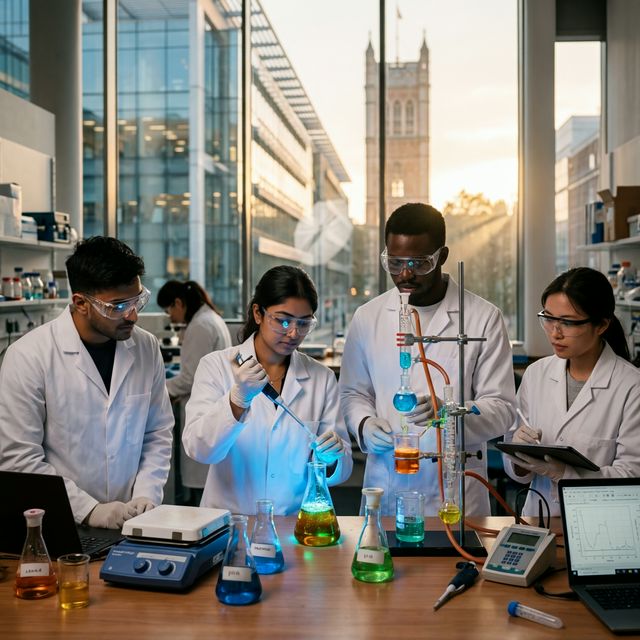
Chemistry is the science of matter and its transformations. It occupies a central position in the natural sciences, providing the molecular-level understanding that underpins biology, medicine, materials science, environmental science, and physics. To study chemistry is to develop a precise, quantitative way of thinking about the world, one that moves between the microscopic behaviour of atoms and electrons and the macroscopic properties of substances that can be measured in a laboratory or observed in a manufacturing process. At Imperial College, one of the world's leading institutions for scientific research and education, you will follow a three-year full-time programme that takes your understanding of chemistry from undergraduate foundations to a level of genuine depth and sophistication. The curriculum covers the principal branches of the discipline, including organic, inorganic, and physical chemistry, as well as areas at the boundaries between them. You will advance your practical skills through an extensive laboratory programme, learning to synthesise chemicals and study chemical systems using experimental measurements and computational models. Alongside bench work you will engage with theoretical frameworks that explain why reactions occur, how energy is transferred, and how molecular structure determines function. Imperial's research environment means that the chemistry you encounter on this programme is connected to live scientific questions. You will develop the skills to read primary literature critically, to design experiments, to analyse data rigorously, and to communicate your findings to specialist audiences. Quantitative reasoning and problem-solving are woven through the degree, and you will become fluent in the mathematical tools that underpin modern chemical science. A BSc in Chemistry from a research-intensive institution opens doors to careers in the pharmaceutical, agrochemical, materials, and energy industries, as well as in environmental consultancy, analytical laboratories, and science policy. Many graduates continue to a Masters or PhD, often progressing into academic research or senior industrial roles. Teaching and science communication are also well-established routes for those who want to share their enthusiasm for the subject.
Syllabus & Modules
Typical curriculumStudent Satisfaction
National Student Survey - 25 respondents (69% response rate)
Similarly Ranked Alternatives

What comes next? 🎓
Choosing the right university starts with choosing the right school. Explore transparent, data-driven school profiles powered by official DfE statistics.
Explore Schools on WhatSchool.ai →