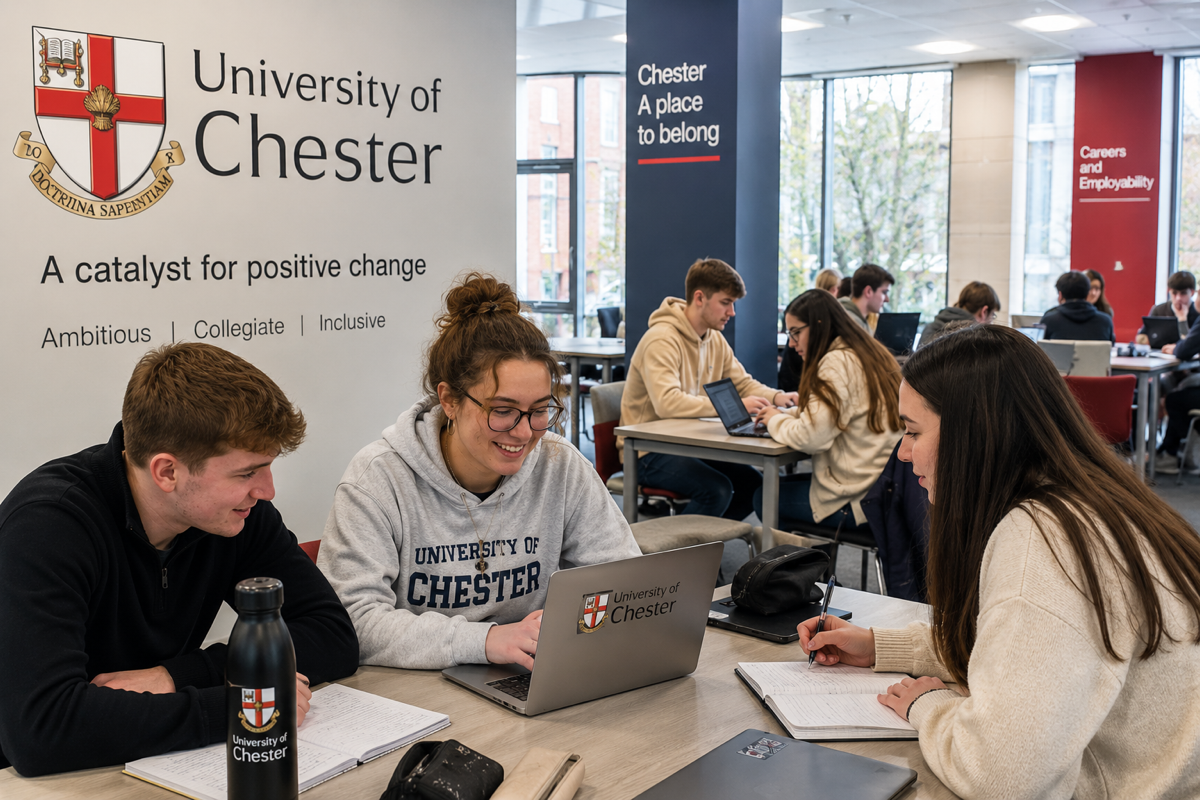
BSc Chemistry
About this course
Chemistry is the central science, providing the molecular understanding that underpins medicine, materials, energy, and the environment. It asks how matter is composed, how substances interact and transform, how new compounds can be synthesised with desired properties, and how the microscopic world of atoms and molecules gives rise to the macroscopic properties of materials and biological systems. These questions sit at the heart of pharmaceutical discovery, materials innovation, environmental monitoring, and our understanding of life itself. At the University of Chester, this three-year, full-time programme develops your knowledge across the three main branches of chemistry: organic, inorganic, and physical. Organic chemistry examines the structure, synthesis, and reactivity of carbon-based compounds, which includes most of the molecules of life and most pharmaceuticals. Inorganic chemistry covers the chemistry of the elements and their compounds across the periodic table, including transition metal complexes that are important in catalysis and medicine. Physical chemistry applies the laws of physics to chemical systems, addressing thermodynamics, kinetics, quantum mechanics, and spectroscopy. Laboratory work is central to the programme: you will develop practical skills in synthesis, analysis, and characterisation using the techniques that chemists employ in research and industrial settings. A typical entry tariff of 104 UCAS points indicates the entry level expected. Chemistry develops systematic problem-solving, quantitative reasoning, attention to experimental detail, and the ability to communicate technical findings clearly. These are capacities that translate well across many professional contexts. Graduates work in the pharmaceutical and biotechnology industries, environmental science, forensic chemistry, materials science, teaching, and industrial chemistry. Many pursue postgraduate study or research, and chemistry graduates are consistently in demand across the science and technology sectors.
Syllabus & Modules
Typical curriculumStudent Satisfaction
National Student Survey - 10 respondents (63% response rate)
Similarly Ranked Alternatives



What comes next? 🎓
Choosing the right university starts with choosing the right school. Explore transparent, data-driven school profiles powered by official DfE statistics.
Explore Schools on WhatSchool.ai →