BSc Chemistry
About this course
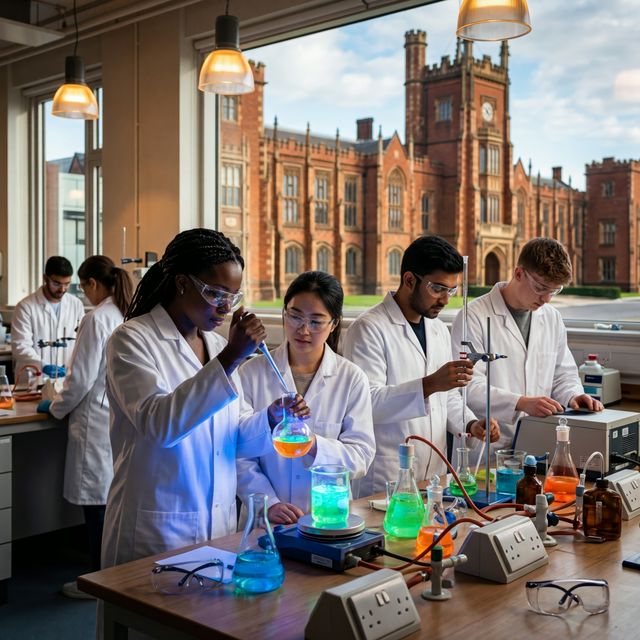
Chemistry is sometimes described as the central science, and with good reason: it underpins biology, physics, medicine, materials science, and environmental science, explaining at the molecular level how matter is structured, how substances react, and how energy is exchanged in those processes. Chemists design and synthesise new molecules, develop analytical tools to detect and quantify substances, and investigate the mechanisms of reactions that range from those occurring in living cells to those used in industrial manufacturing. The breadth of chemistry's applications, from drug discovery and materials development to environmental monitoring and food science, makes it one of the most versatile and employable of the natural science degrees. At Queen's University Belfast, this three-year full-time degree builds a deep and systematic understanding of chemical principles across the main sub-disciplines: organic chemistry, inorganic chemistry, physical chemistry, and analytical chemistry. You will develop strong laboratory skills alongside theoretical knowledge, learning to design experiments, handle instrumentation, and interpret data with precision. Transferable skills in quantitative problem-solving, critical analysis, and scientific writing are built throughout the programme, giving you competencies that extend well beyond chemistry itself. Queen's emphasis on the practical and applied dimensions of chemistry connects your learning to real challenges in drug development, sensing technology, and environmental management. Chemistry graduates are consistently among the most employable of science graduates. Direct career pathways lead into the pharmaceutical and biotechnology industries, chemical manufacturing, materials science, environmental analysis, and food and consumer products. Many graduates enter roles in research and development, quality control, regulatory affairs, patent law, or technical sales. The strong analytical and problem-solving skills the degree develops also make chemistry graduates attractive to employers in finance, consulting, and the technology sector. Postgraduate study, either through an MSc or a PhD, is the route into academic research and into senior research roles in industry.
Syllabus & Modules
Typical curriculumStudent Satisfaction
National Student Survey - 15 respondents (78% response rate)
Similarly Ranked Alternatives



What comes next? 🎓
Choosing the right university starts with choosing the right school. Explore transparent, data-driven school profiles powered by official DfE statistics.
Explore Schools on WhatSchool.ai →