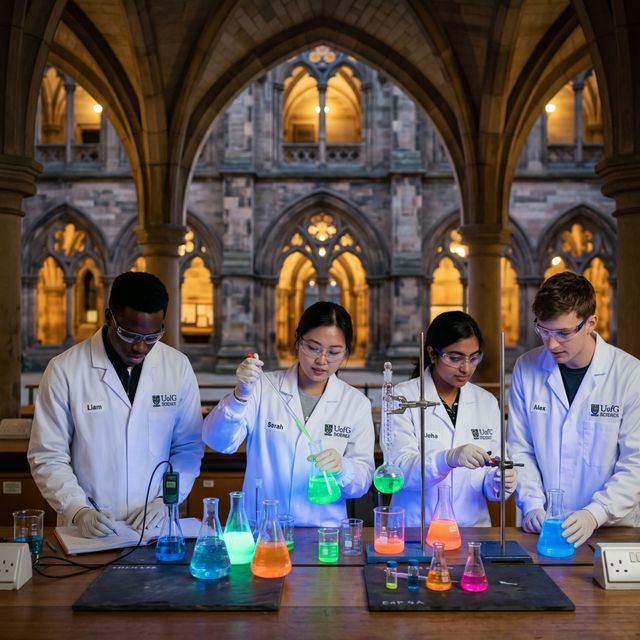
BSc Chemistry
About this course
Chemistry is the science of molecules and materials, the discipline that asks what substances are made of at the molecular level, how they transform in chemical reactions, and how the properties of matter can be understood and manipulated. It is central to modern life in ways that are not always visible: every drug that treats illness, every material that builds a phone or an aircraft, every fertiliser that feeds crops, and every analysis that detects a contaminant has chemistry at its heart. As a science, it is grounded in rigorous theory and experimental practice, developing a way of thinking about matter that is precise, quantitative, and creative. At the University of Glasgow this four-year programme includes a year abroad, giving you the opportunity to study in another country and to encounter different approaches to chemistry research and education. Chemistry at Glasgow is described by the University itself as a science with a well-developed theory base that continues to make advances in areas such as new materials, antibiotics, semiconductors, and trace analysis. You will develop a thorough grounding in organic, inorganic, physical, and analytical chemistry, alongside laboratory skills that are central to working as a chemist in any professional context. The four-year Scottish degree provides additional breadth in the early years before honours specialisation. Chemistry graduates work in pharmaceuticals, materials science, chemical engineering, forensic science, food and drink, environmental monitoring, energy, and academia. Many pursue industrial research and development roles, working to create new substances and materials or to understand how existing ones can be improved or replaced. The analytical and quantitative skills developed in the degree are also valued in finance, consulting, and data-intensive roles. Further study at postgraduate level, including a doctorate in chemistry or a specialist discipline such as medicinal chemistry, materials chemistry, or environmental chemistry, is pursued by many graduates and opens careers in academic and industrial research.
Syllabus & Modules
Typical curriculumStudent Satisfaction
National Student Survey - 15 respondents (71% response rate)
Similarly Ranked Alternatives


What comes next? 🎓
Choosing the right university starts with choosing the right school. Explore transparent, data-driven school profiles powered by official DfE statistics.
Explore Schools on WhatSchool.ai →