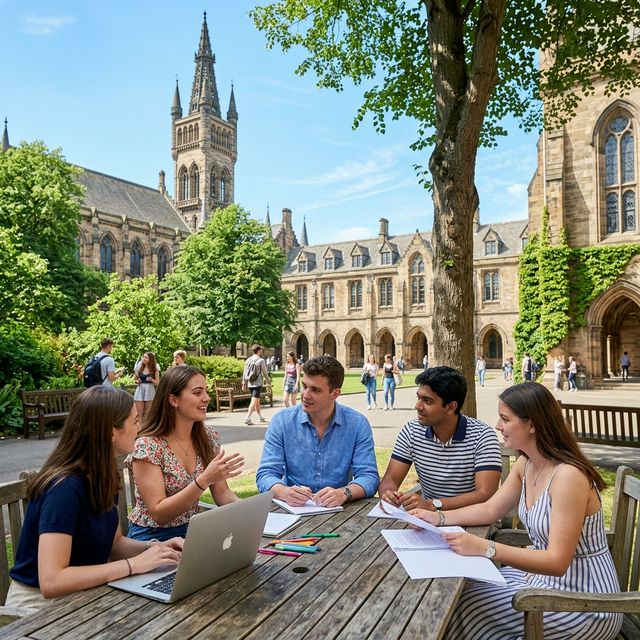
MA Economic & Social History/English Literature
About this course
Economic and social history and English literature is a pairing that brings together two disciplines deeply concerned with understanding the texture of human life over time: one through the structures, institutions, and material conditions that shape societies, and the other through the stories, voices, and imaginative forms that people use to make sense of experience. Economic and social history asks how economies developed, how inequalities were created and contested, how people worked and lived across different periods and places, and how social change happens. English literature engages with the texts through which writers have captured, interpreted, and shaped those experiences. Together, they develop a distinctive capacity to understand the past with both analytical rigour and imaginative depth. At the University of Glasgow, this part-time programme allows you to pursue both disciplines alongside other commitments. Your economic and social history studies will take you across the economic and social transformations of the modern era, engaging with primary sources, quantitative and qualitative methods, and the major debates in the historiography of labour, poverty, industrialisation, and social reform. Your English literature studies will take you from early modern to postmodern writing, benefiting from Glasgow's expertise in American, Irish, and postcolonial literatures, critical theory, creative writing, and the relationship between literature and other arts, media, and science. A year abroad is part of the programme, giving you the opportunity to study at a partner institution and to encounter both historical and literary traditions in a different academic context. You will develop strong research, analytical writing, and critical skills across two genuinely demanding disciplines, with the breadth to engage with both structural and cultural dimensions of the past. Graduates go on to careers in research, education, journalism, heritage, archiving, the civil service, and cultural organisations. Postgraduate study in history, English, or museum studies is a natural continuation.
Syllabus & Modules
Typical curriculumStudent Satisfaction
Missing Satisfaction Data
The university has not shared complete student satisfaction records for this specific degree metrics block. You may want to formally explore these topics with the university staff at an open day before committing.
What comes next? 🎓
Choosing the right university starts with choosing the right school. Explore transparent, data-driven school profiles powered by official DfE statistics.
Explore Schools on WhatSchool.ai →