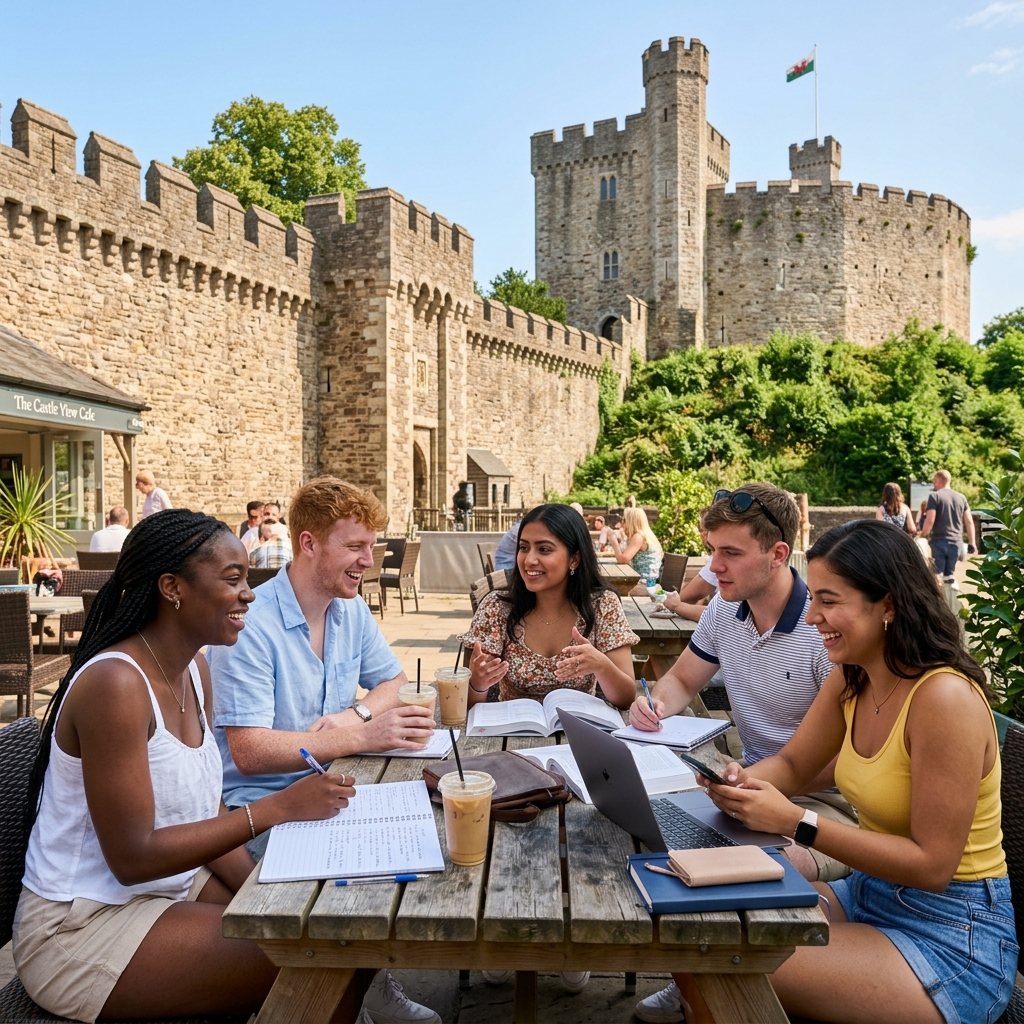
BA Media and Communications
About this course
Media and communications sits at the centre of contemporary social, cultural, and political life. It asks how messages are produced, distributed, and received; how media institutions shape public understanding; and how audiences make sense of the images, stories, and information that surround them. It combines theoretical rigour with practical awareness of how media industries actually work. At Cardiff University, one of the UK's leading centres for media research and journalism education, you will study the full range of media forms, from broadcasting and print to digital platforms and social media. You will engage with key questions in the field: how do ownership structures affect editorial decisions? How do audiences actively construct meaning rather than passively receive it? What is the relationship between media representation and social inequality? You will develop analytical frameworks drawn from sociology, cultural theory, political economy, and semiotics, and apply them to real examples drawn from news media, entertainment, advertising, and digital communication. The programme runs over three years full time and combines seminars, screenings, and independent research. Cardiff's strong connections to the Welsh and UK media industries, along with the proximity of major broadcasters and news organisations, make it a particularly well-connected place to study media. You will develop skills in critical analysis, research, argument construction, and communication that are relevant to professional practice as well as to academic understanding. Graduates go on to careers in broadcasting, journalism, public relations, advertising, digital communications, the creative industries, and policy. Others move into roles in research, consultancy, and the non-profit sector where understanding of media and communication is a practical asset. Many also continue to postgraduate study in media studies, journalism, communications, or related disciplines.
Syllabus & Modules
Typical curriculumStudent Satisfaction
National Student Survey - 45 respondents (62% response rate)
Similarly Ranked Alternatives

What comes next? 🎓
Choosing the right university starts with choosing the right school. Explore transparent, data-driven school profiles powered by official DfE statistics.
Explore Schools on WhatSchool.ai →